Japandi Bathroom Ideas
Japandi is one of the most searched bathroom styles in the UK right now — and for good reason. It is calm without being cold, minimal without being bare, and easier to achieve than most design movements. This guide covers what the style actually means, how to apply it in a bathroom, and the material choices that make the difference between a room that looks japandi and one that genuinely is.
What Is Japandi Style?
Japandi is the design hybrid of Japanese minimalism and Scandinavian simplicity. Both traditions share a deep respect for natural materials, honest craftsmanship, and the belief that good design is self-effacing — it doesn't announce itself. Where they differ is in mood: Japanese design tends toward the austere and meditative, while Scandinavian design introduces warmth, texture, and a sense of domestic comfort. Japandi sits at the intersection of the two.
In practice, a japandi interior reads as a room that has been considered rather than decorated. Materials are natural and purposeful. There is no ornament for ornament's sake. Surfaces are calm, clean, and honest — but the room never feels unwelcoming or clinical. This is what separates japandi from pure minimalism: it is still a room people want to spend time in.
Japandi Bathroom Ideas: The Key Principles
1. Choose Natural Materials and Let Them Speak
The most important decision in a japandi bathroom is material selection. Natural materials — stone, timber, linen, clay — are essential. Composite materials that mimic these aren't wrong, but the effect is always stronger when the material is authentic.
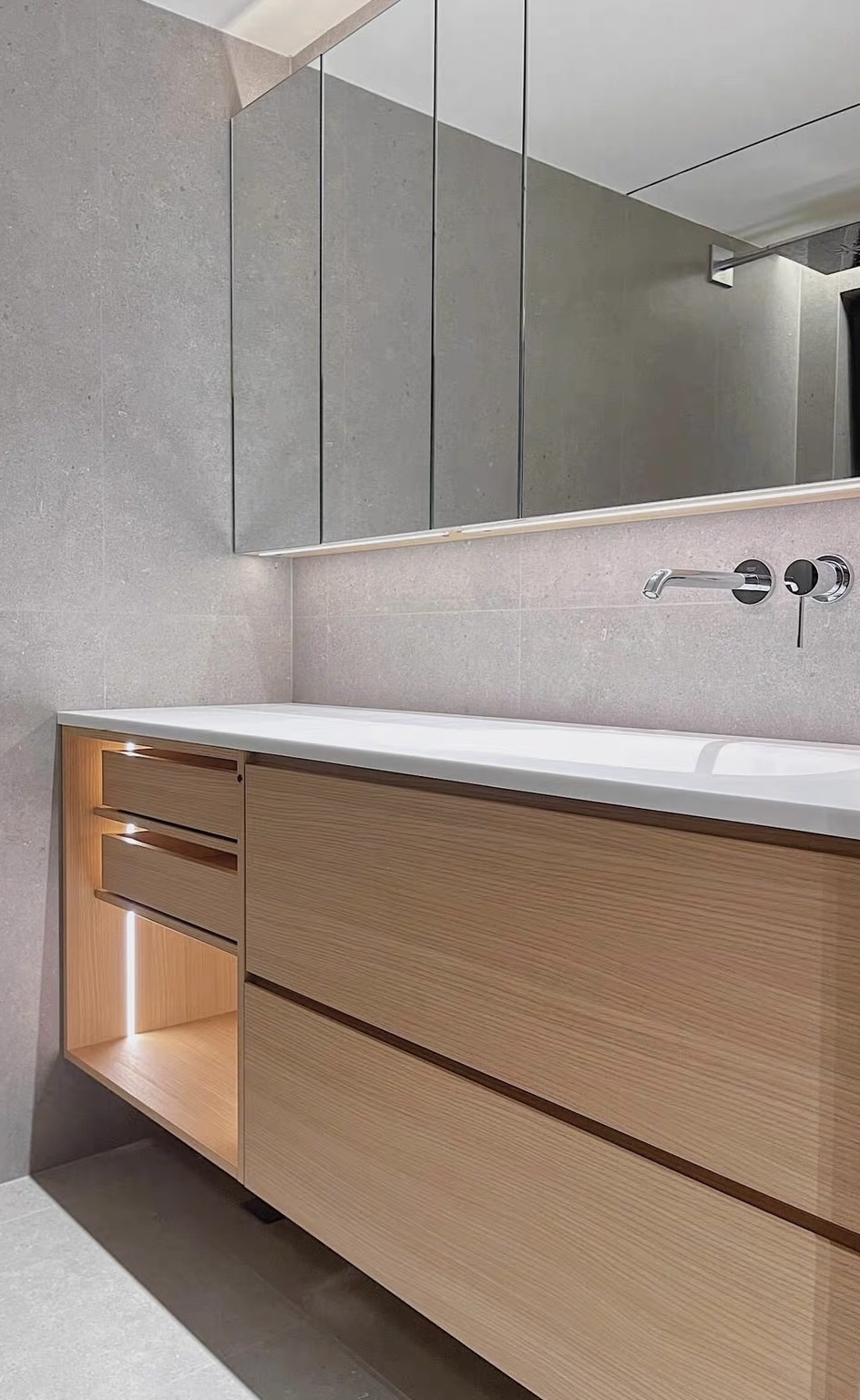
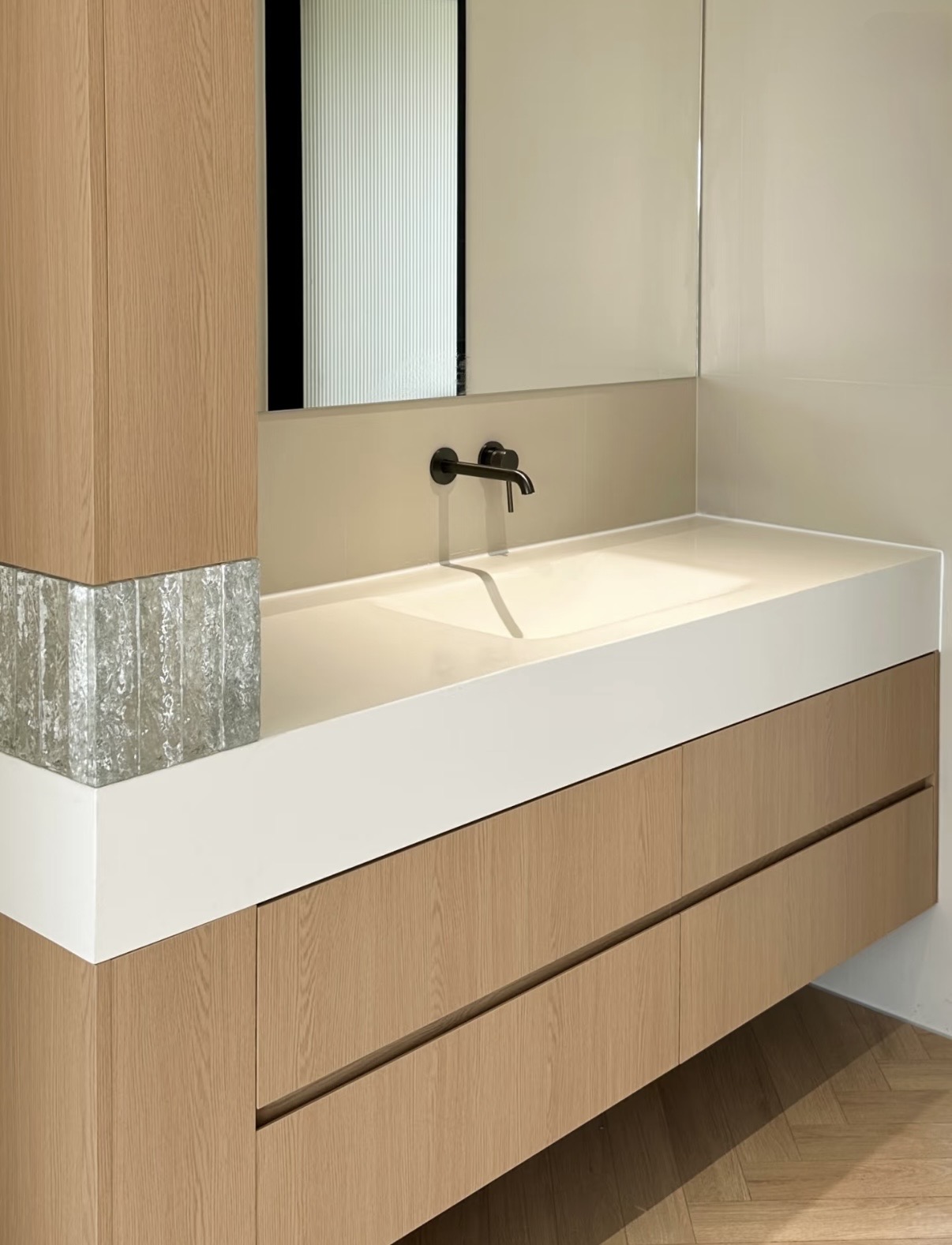
For the basin and worksurface, sintered stone is the closest thing to an ideal japandi material. It has the visual weight of concrete and the refined quality of natural stone, without the porosity or maintenance that comes with marble or limestone. For cabinetry, warm oak veneer is the definitive choice: light, even-grained, honest about what it is.
2. Work Within a Restrained Tonal Palette
Japandi colour is not grey or white — it is the natural colour of the materials themselves. Warm cream, pale stone, honey oak, matte clay. The palette should feel like it was found rather than chosen. Avoid colours that compete with each other; instead, layer tones that belong to the same family.
In a bathroom, this typically means: a light warm-grey stone basin and counter, warm oak cabinetry, off-white or limewashed walls, and hardware in a matte or brushed finish (brushed brass or satin chrome — not polished). Avoid cool-toned greys, stark white, and high-gloss surfaces of any colour.
3. Eliminate Visual Noise
Every visible decision in a japandi bathroom should be deliberate. Exposed pipework, deck-mounted taps on a clean stone surface, unsightly storage — each of these introduces a visual interruption that works against the calm the style requires.
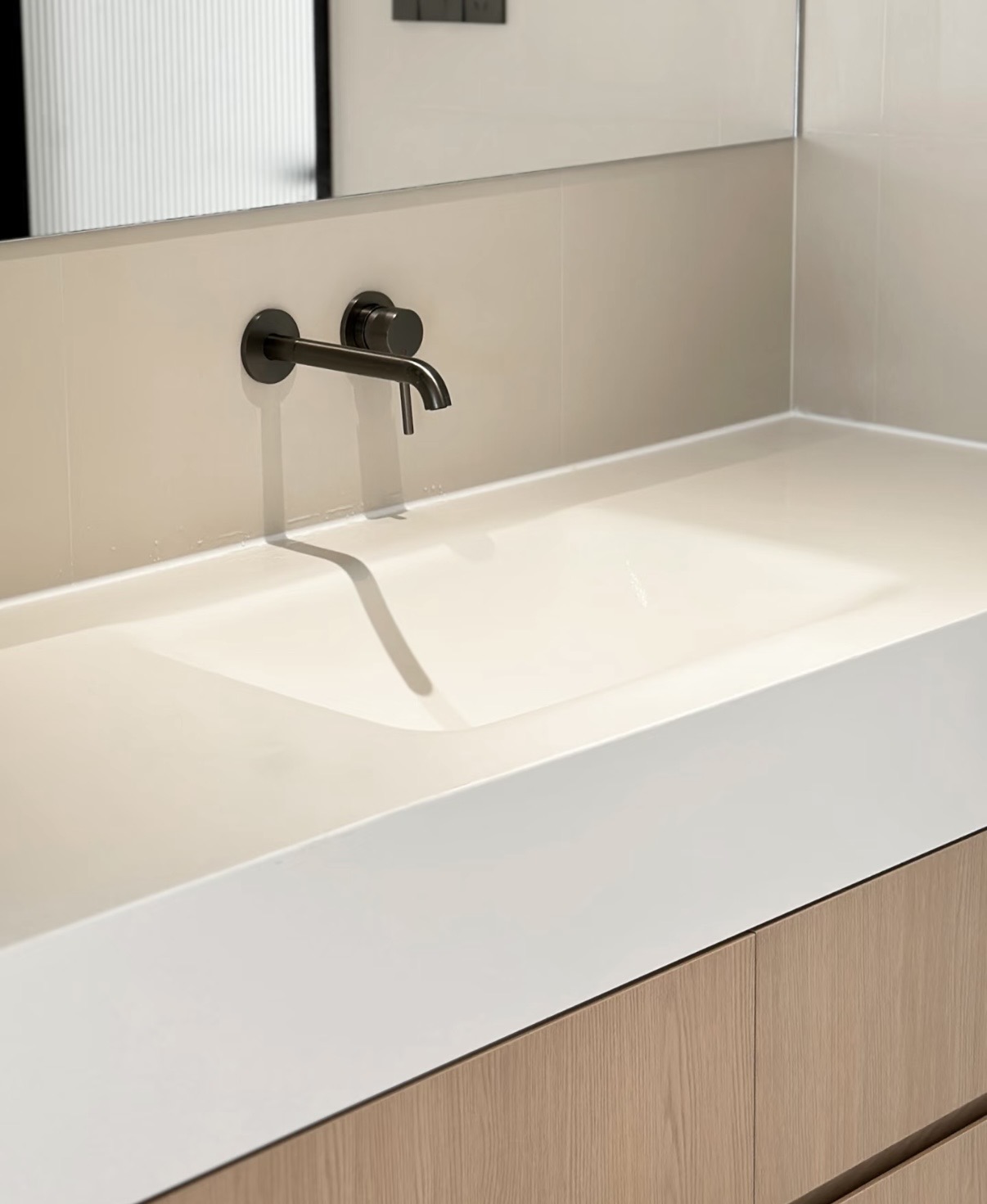
Wall-mounted taps keep the basin surface unbroken. Integrated storage (drawers within the vanity rather than freestanding shelves) reduces visual complexity. A basin without an overflow aperture maintains the clean mineral surface of the stone from edge to bowl without interruption. Small decisions, significant cumulative effect.
4. Get the Horizontal Lines Right
Japandi bathrooms are typically horizontal in emphasis — the vanity runs the full width of the wall, the mirror follows, the stone flows edge to edge. This horizontality is what gives the style its sense of calm and spaciousness, even in smaller bathrooms.
An off-the-shelf vanity rarely achieves this because it is designed to fill a standard space, not a specific one. A 1200mm vanity in a 1340mm alcove leaves a 70mm gap on each side — and those gaps undo the effect. Bespoke width is not a luxury in a japandi bathroom; it is part of what makes the room work.
5. Let Natural Light Do the Work
Japandi interiors rely on natural light for warmth rather than decorative lighting. In a bathroom, this means maximising natural light where possible, and where artificial lighting is needed, choosing recessed or concealed sources that illuminate rather than decorate. An LED strip behind or below the vanity unit creates a soft ambient glow without being visible as a fitting.
The Japandi Basin: What to Look For
The basin is the visual centrepiece of a japandi bathroom, and the choice of basin has more impact on the overall look than almost any other element. Here is what to look for:
Integrated, Not Drop-In
A drop-in basin (bowl set into a countertop) has a visible rim where the bowl meets the surface. That rim is a join — a visual seam that breaks the flow of the material. An integrated basin flows from flat surface into bowl in a single continuous piece of stone. No rim, no join, no interruption. This seamlessness is fundamental to the japandi aesthetic.
No Overflow
An overflow aperture is a practical feature that adds a visible fitting to the interior of the basin. In a japandi context — where the inside of the bowl is as considered as the outside — this is worth eliminating. A no-overflow basin is cleaner, easier to keep clean, and more resolved aesthetically.
Made to Width
As noted above, the width of the vanity matters. A japandi basin that runs the full width of its wall (or alcove, or nib wall) reads very differently to one that falls short. Bespoke stone basins in sintered stone can be made to any width from 700mm to 2400mm — matching the room exactly rather than approximating it.
Wall-Mounted Tap Position
Deck-mounted taps sit on the stone surface and break its horizontal plane. Wall-mounted taps project from the wall above the basin, leaving the stone surface entirely uninterrupted. In a japandi bathroom, the tap should be barely visible — present when you need it, absent from the composition when you don't.
Japandi Bathroom Ideas by Room Type
Small Japandi En-Suite
Small bathrooms are where japandi discipline pays off most. A single basin vanity at 700–900mm, a semi-recessed basin to minimise projection, warm oak fronts, wall-mounted tap, and a frameless mirror above. No freestanding storage — everything within the vanity. The effect is a room that feels intentional rather than cramped.
Family Bathroom
A japandi family bathroom works best with a wider vanity (1200–1600mm) that provides real storage, a single basin to one side, and a considered layout that doesn't fight for space. Warm oak with soft-close drawers, sintered stone surface that wipes clean instantly. Practical and resolved — the two qualities that matter most in a room with daily heavy use.
Master En-Suite
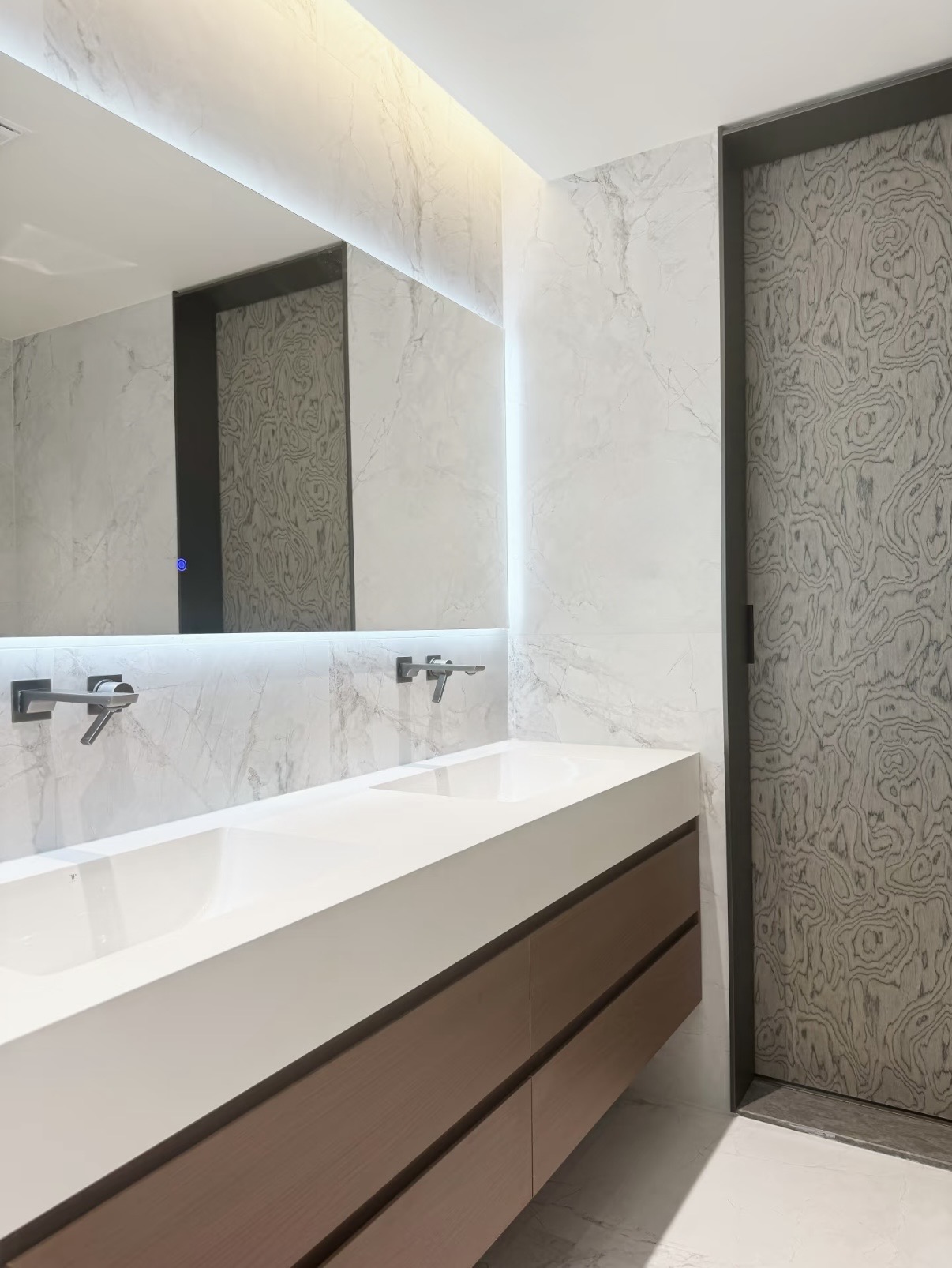
The master en-suite is where japandi can be taken to its fullest expression: a double basin vanity at 1800–2400mm, twin wall-mounted taps, a full-length mirror cabinet above, and plinth lighting below for a floating glow at night. Warm Caribbean Walnut or North American Oak, pale grey sintered stone. The room becomes the centrepiece of the house.
Design Your Japandi Bathroom Basin
Specify your exact width (700–2400mm), bowl position, wood finish and edge profile. We'll send a complimentary 3D concept and full itemised quote within 48 hours.
View Minimal Japandi Collection Start Designing →